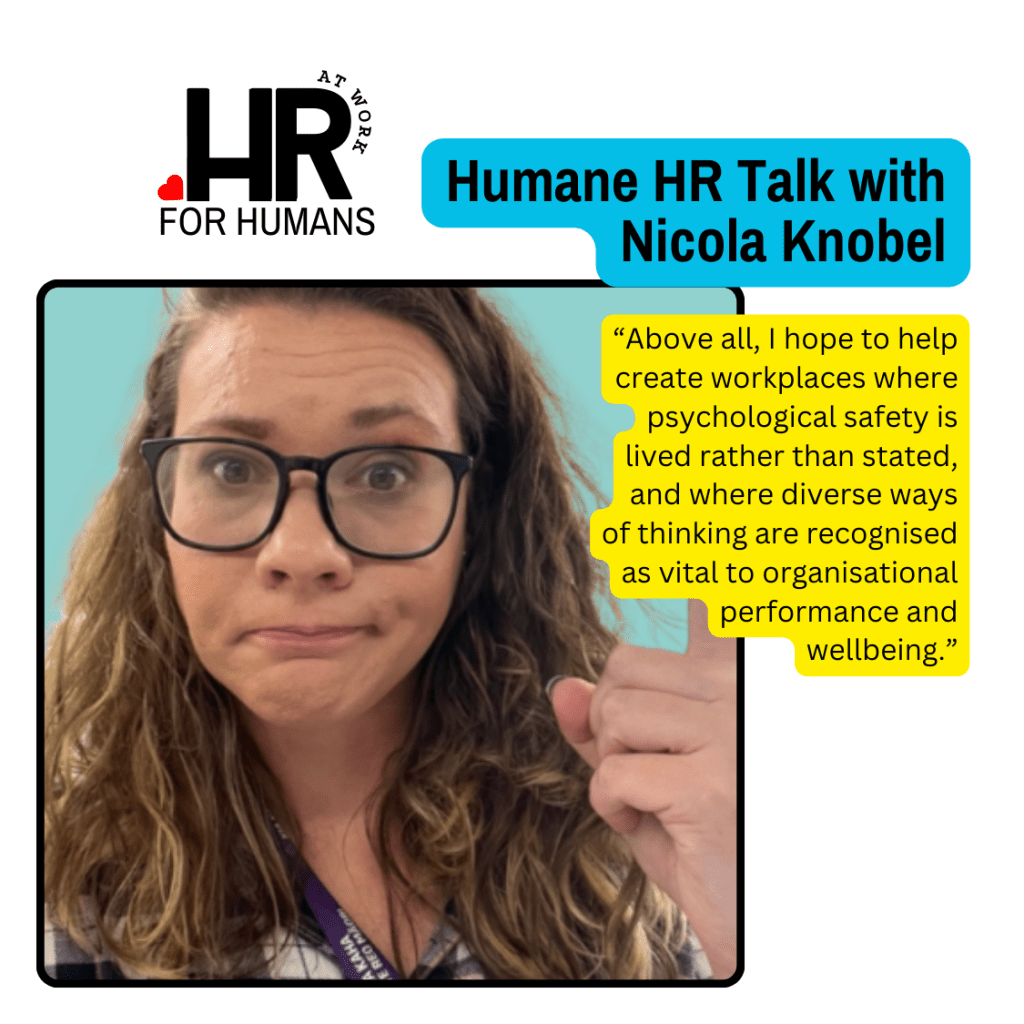
We speak with Nicola Knobel, a safety, risk, and assurance leader committed to reshaping how organisations approach health, safety, and workplace culture — especially through a lens that values neurodiversity, psychological safety, and human-centred design. In this interview, she will reflect on how her background and lived experience influence her approach to workplace governance and risk, and share her vision for leadership frameworks that support all people rather than fitting everyone into a narrow mould. Our conversation invites her to describe in her own words why neuro-inclusive safety matters, and how rethinking traditional systems can shape more equitable, supportive workplaces.
Nicola, thank you for being open to this conversation. Could you start by introducing yourself — telling us about your background, how you came to work at the intersection of safety, risk, and neuro-inclusive leadership, and what motivates you?
I am the Head of Safety, Risk and Assurance for a charity in New Zealand, and my work sits where human behaviour, organisational systems, and risk intersect. I began in very traditional health and safety roles where the focus was on compliance, procedures, and preventing physical harm. Over time I realised I was more drawn to the questions behind the systems. Why do people work the way they do? What makes work harder or easier? What sits beneath behaviour? That curiosity pulled me into strategy, governance, culture, and later into assurance. I completed a Master of Laws specialising in health and safety and employment because I wanted to understand the legal frameworks that shape our decisions and the obligations that influence how leaders think about risk. What motivates me now is creating systems that are not only legally compliant, but actually work for people. I care deeply about equity and Te Tiriti, and my practice is grounded in the belief that organisations thrive when they design for human reality rather than for an imagined ideal of the perfect worker.
You describe yourself as neurodivergent (AuDHD), and you’ve spoken about how this influences the way you see risk, safety, and human systems. Can you share how your lived experience shaped your perspective on organisational safety and inclusion?
Being AuDHD has profoundly shaped the way I understand risk, safety, and human systems. I notice patterns quickly and see gaps in processes before others realise they exist. I also pick up on tone, emotion, and unspoken pressure points that never show up in dashboards. For years I did not know I was neurodivergent, and I masked intensely to fit into environments that were not designed for people like me. That experience taught me how unsafe and exhausting workplaces can feel when you are constantly compensating for systems built around a narrow view of what is normal. It also showed me how many organisational risks are actually created by cultural expectations, workload, and unclear communication. My lived experience gives me a strong sense of fairness. When systems consistently fail neurodivergent people, they usually reveal deeper systemic issues that affect everyone. This perspective has shaped my belief that psychological safety and accessibility must be core elements of any modern safety or risk framework.
You have worked across health, safety, risk governance, and organisational assurance — often with a focus on people-centred design rather than compliance-only models. What led you to move from traditional safety frameworks toward this holistic, human-centred approach?
Early in my career I saw that traditional safety frameworks were heavily focused on documentation and rules. They were designed to create control, not to understand work as it really happens. The more time I spent with frontline teams, the more obvious it became that risk sits within culture, relationships, clarity, capability, mental load, and the daily pressures people carry. You cannot fix those things by writing more procedures. I started moving toward a human-centred approach when I realised that people do their safest work when systems make sense, when leadership is predictable, when communication is clear, and when the organisational climate reduces rather than adds to cognitive strain. This shift was also influenced by my work in risk governance and assurance. I saw that organisations collect large amounts of data, but often miss the insights that sit within human experience. For me, a human-centred approach is not a soft alternative to compliance. It is a practical necessity for good risk management.
In your view, why do traditional employment contracts and standard governance frameworks sometimes fail to accommodate neurodiversity or Indigenous ways of working (for example, tikanga-based frameworks)? What aspects need rethinking?
Standard employment contracts and governance processes often assume a narrow version of work. They assume people can consistently produce at the same pace, communicate in conventional ways, and tolerate environments that may be noisy, busy, or socially demanding. These frameworks rarely reflect the relational, collective, and wellbeing-centred concepts found in Māori or Pacific world views, or the variability of neurodivergent experience. They embed assumptions about productivity, professionalism, and behaviour that have never been neutral. They simply reflect the dominant culture that designed them. To support people better, organisations need to rethink the language used in contracts, the expectations placed on workers, and the governance structures that shape how decisions are made. We need frameworks that recognise human variability as standard, not as an exception requiring special accommodation.
You’ve written and spoken about psychological safety, neuro-inclusive leadership, and organisational risk culture. What are the core principles you believe organisations should adopt to support neurodivergent and neuro-diverse-thinking people effectively?
For me, a few principles make a significant difference when supporting neurodivergent people. Transparency and predictability help reduce cognitive load and make expectations clear. Flexibility in how work is done allows people to use their strengths without fear of penalty. Permission to work differently must be normalised so people are not forced to mask. Sensory and cognitive accessibility should be designed into workplaces from the beginning, not added as an afterthought. Leadership capability is essential. Leaders need practical skills in inclusive communication, feedback, and workload management. Finally, psychological safety must be prioritised at a governance level so it is protected and monitored like any other critical risk control.
As someone working in risk and safety leadership, how do you balance the demands of regulatory compliance, organisational governance, and human-centred flexibility — especially in environments that may resist change?
Compliance is essential, but it is only the foundation. My role involves meeting regulatory requirements while ensuring that the systems built around those requirements do not create harm. This balance requires close collaboration with ELT and Boards. I bring data, narrative, and lived experience together to show that flexibility does not undermine governance. In fact, human-centred systems improve risk visibility and create environments where people feel safe to speak up about issues before they escalate. The biggest shift comes when leaders understand that culture, workload, and psychological safety are risk controls, not optional extras. I maintain this balance by staying purpose-led, evidence-informed, and connected to the people who do the work every day.
For organisations or leaders aiming to become more inclusive and supportive of neurodiversity (or diverse ways of thinking), what practical steps or changes would you recommend — especially around risk culture, governance, and contract design?
There are concrete steps organisations can take. First, review governance documents, policies, and procedures with a lens of inclusion and cognitive diversity. Many hidden assumptions sit in the way language, deadlines, and expectations are framed. Second, bring neurodivergent workers into co-design. They hold insights that cannot be captured through surveys alone. Third, simplify contracts and job descriptions and build in flexibility so expectations are clear but not rigid. Fourth, report psychosocial risk at governance level so it is treated with the same seriousness as physical harm. Fifth, train leaders in practical neuro-inclusive communication and supervision. And finally, normalise adjustments. Noise-reducing tools, meeting-free zones, or alternative communication methods are simple changes that can transform work for a wide range of people.
Given your combined interest in law, safety, neurodiversity, and equitable design — how do you envision the future of work, especially in how workplaces are structured, contracts are written, and systems of leadership are built?
I envision workplaces that recognise human variability as a core truth. Contracts will be simpler, more transparent, and designed to accommodate fluctuating energy, focus, and communication needs. Leadership will be relational, psychologically safe, and grounded in trust rather than surveillance. Risk and governance frameworks will value culture and capability as strongly as they value controls. Workplaces will be designed around inclusion from the outset, rather than retrofitted when someone is struggling. In this future, neurodivergence will be seen as a normal and valuable part of the workforce, not something people hide. The systems we build will support people to thrive, not just survive.
What have been the most challenging moments in pushing for change — either internally within organisations, in legal or regulatory contexts, or socially — and how have you navigated resistance?
The biggest challenges come when people default to control and compliance because it feels safer or more familiar. Resistance often appears when leaders fear the regulatory consequences of doing things differently. I navigate this by grounding conversations in evidence, legal obligations, and human impact. I show what the risks are when people do not feel safe to speak up or when systems create strain. Over time, resistance softens when leaders see that human-centred systems improve reporting, build trust, and reduce harm. Navigating resistance is about patience, clarity, and connecting people back to purpose.
Looking ahead: what are your aspirations for your work over the next 5–10 years? How do you hope your efforts will influence broader conversations about equity, neurodiversity, safety, and inclusion in workplaces?
In the next decade I want to influence the way organisations think about neurodiversity, safety, and risk culture. I plan to keep writing, speaking, and building practical tools that support leaders and teams. My aspiration is to shape safer, more equitable workplaces throughout Aotearoa and beyond, where governance frameworks reflect human reality and where culture is recognised as a critical control. I want to contribute to a shift where neuroinclusive practice becomes standard, not exceptional, and where leaders feel confident in supporting diverse ways of thinking.
If you were to write your bio in your own words, what would you say? What legacy would you like to leave?
If I were to write my bio today, I would describe myself as a leader dedicated to building safer, more human systems across Aotearoa. My work brings together law, risk, neurodiversity, and organisational design, and is grounded in a commitment to equity, Te Tiriti, and inclusive practice. I lead Safety, Risk and Assurance for an amazing charity, hold a Master of Laws specialising in health and safety and employment, and have developed organisation-wide frameworks for psychosocial risk, risk appetite, culture, and assurance. I speak and write widely about neurodivergent leadership, psychological safety, and modern risk practice, and I am the author of a book focused on the future of neuroinclusive workplaces.
My aspiration is to leave a legacy defined by clarity, fairness, and courage. I want my work to contribute to systems that honour people, reduce harm, and make complexity understandable and manageable. Above all, I hope to help create workplaces where psychological safety is lived rather than stated, and where diverse ways of thinking are recognised as vital to organisational performance and wellbeing.
Link
Visit Nicola’s website here
About Humane HR Talk
Welcome to Humane HR Talk, where we present insightful interviews with HR industry experts and thought leaders in related fields sharing their strategies, perspectives, and visions for creating more human-centric workplaces. Through these discussions, you’ll gain practical tips and fresh inspiration to transform your HR practices, to foster inclusive, thriving cultures, and to help in your own journey in the evolving world of work.
Share Your Insights
We’d love to hear your thoughts! Share your insights in the comments below.
- What stood out to you about humane HR from what you’ve read?
- What has worked well in your organisation or business?
- What would you recommend?
Disclaimer and Other Relevant Information
The insights and any linked resources in our content are for informational purposes only and do not constitute professional advice. The opinions expressed in our articles reflect the contributors’ perspectives and do not necessarily represent the views of our entire platform. Please consult our policies for more information.
Here are the shortcuts to our policies that must be read along with each other:
- Terms of Service
- Disclaimer and Disclosure
- Privacy Policy
- Voluntary Contribution Policy
- Editorial Guidelines
- Content Submissions
For more details about us and what we do, here are some of the links:
- About Us
- Blog
- Book Review Request Step 3
- Book Reviews and Requests
- Contact
- Content Submissions
- Disclaimer
- Editorial Guidelines
- Humane HR Awards
- Humane HR Awards Winners
- Humane HR Book Reviews
- Humane HR Perspectives
- Magazine
- News
- Our Supporters
- Privacy Policy
- Subscribe
- Support Us
- Terms of Service
- Voluntary Contribution Policy
Here are shortcuts to our content:
- All About Humanising HR
- Book Reviews
- Compensation and Benefits
- Compliance
- Diversity and Inclusion
- Employee Engagement
- Employee Relations
- Humane HR Awards
- Humane HR Perspectives
- Humane HR Talk
- Morale and Welfare
- News and Announcements
- Performance Management
- Recruitment and Selection
- Talent Management
- Training and Development
- Workplace Change Management
- Workplace Communications
- Workplace Health and Safety
Nominate for the Humane HR Awards
Let’s recognise, celebrate, and encourage what’s making the world of work better. It’s free to nominate. Submissions are open all year-round, but why wait? Nominate today!


 HR for Humans at Work
Leave a comment