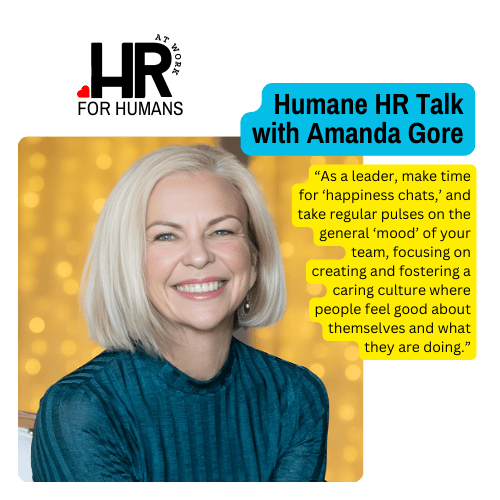
In this Humane HR Talk edition, Amanda Gore, an expert in workplace health and leadership, shares a measure she has used to ensure a safe and healthy work environment: fostering a culture of care.
Amanda highlights the importance of human connection, leader self-awareness, and psychological safety. She explains that while solutions like ergonomics and occupational health matter, the most effective change comes from leaders who care about their people. Through ‘happiness chats’—informal moments of connection—Amanda encourages leaders to engage with their teams, making employees feel valued and supported. This approach reduces workplace stress and improves engagement and well-being.
Read further to know how plus more from Amanda.
What is one effective measure you have implemented to ensure a safe and healthy work environment for all employees?
We, humans, have not changed much emotionally and psychologically for thousands of years! What matters to us is how cared for, valued, seen, and heard we feel. According to McKinsey, 75% of people find their boss the most stressful part of their day, so reducing stress by improving the self-awareness of leaders is one of the most effective measures to provide psychological safety at work.
So the one effective measure is to create a culture of caring—the currency of care. Although this is not as tangible as measures I have used in the past, it is ultimately by far the most effective.
As a co-author of Pause Gymnastics, one of the first books published many years ago on the value of regular rest breaks, and author of The Office Athlete and Stress Busters, I have been involved in physical therapy, ergonomics, and occupational health, and now mental health at work, for over 35 years. Back then, I worked with Repetition Strain Injuries, which always had a stress/emotional element involved. These days, I speak about Joyonomics and help organisations and leaders understand that creating more joyful cultures makes significant changes to the bottom line.
One of the best leaders and leadership coaches I have ever encountered is Ken Wright, and in his book The People Pill, he talks about ‘coffee chats’. As a leader of very large teams, he would walk around and each week have impromptu ‘coffee chats,’ which I called happiness chats. These were opportunities for him to connect heart to heart with people and let them feel cared for as he asked them what was going well, what wasn’t, and what he could do about it to help them.
This simple human connecting measure creates happier, more engaged employees who are much less likely to feel burnt out, unsafe, or become quiet quitters.
Ask yourself the question—whether you are a leader or not—how do people feel when they are around me? Most of us are so focused on how we are feeling about ourselves and suffering from FOWOT—fear of what others think—that we rarely pay attention to how others might feel around us! To modify Carl Buechner’s quote, “People will forget what you say, they will forget what you feel, but they will never forget how they felt around you.”
And then focus on genuinely caring about others—being curious and interested in them and how they are feeling and what is going on for them. As a leader, make time for ‘happiness chats,’ and take regular pulses on the general ‘mood’ of your team, focusing on creating and fostering a caring culture where people feel good about themselves and what they are doing.
You emphasize the importance of joy in leadership. Can you share a personal experience where joy significantly impacted your team’s performance?
Gratitude is one of the components of joy, and when we started a new ritual at staff meetings, things changed. This ritual was to begin every meeting with everyone answering the question, “What’s the thing you are most grateful for since we last met?” It changes the focus they bring to the meeting and puts them into their hearts rather than their minds, so they connect and engage better.
In your view, what are the most effective strategies leaders can use to create a joyful workplace culture?
Introduce the gratitude question into every staff meeting—make it a ritual.
Truly care for people: Humans have not changed much emotionally and psychologically for thousands of years! What matters to them is how cared for, valued, seen, and heard they feel. According to McKinsey, 75% of people find their boss the most stressful part of their day, so reducing stress by improving the self-awareness of leaders is one of the most effective measures to provide psychological safety at work. Creating a culture of caring is ultimately by far the most effective.
As co-author of Pause Gymnastics, one of the first books published many years ago on the value of regular rest breaks, and author of The Office Athlete and Stress Busters, I have been involved in physical therapy, ergonomics, and occupational health—and now mental health at work—for over 35 years. Back then, I worked with Repetition Strain Injuries, which always had a stress or emotional element involved. These days, I speak about Joyonomics and help organisations and leaders understand that creating more joyful cultures makes significant changes to the bottom line.
One of the best leaders and leadership coaches I have ever encountered is Ken Wright, and in his book The People Pill, he talks about “coffee chats.” As a leader of very large teams, he would walk around and each week have impromptu “coffee chats,” which I called happiness chats. These were opportunities for him to connect heart-to-heart with people and let them feel cared for as he asked them what was going well, what wasn’t, and what he could do about it to help them. This simple human connection creates happier, more engaged employees who are much less likely to feel burnt out, unsafe, or become quiet quitters.
Ask yourself the question—whether you are a leader or not—how do people feel when they are around me? Most of us are so focused on how we feel about ourselves and suffer from FOWOT (fear of what others think) that we rarely pay attention to how others might feel around us. To modify Carl Buechner’s quote, “People will forget what you say, they will forget what you feel, but they will never forget how they felt around you.”
Focus on genuinely caring about others—being curious and interested in them, how they feel, and what is going on for them. As a leader, make time for happiness chats, take regular pulses on the general mood of your team, and focus on creating and fostering a caring culture where people feel good about themselves and what they are doing.
You mention the concept of “handling disruptive change.” What role does joy play in navigating challenging transitions within organisations?
When employees and teams have a strong culture of caring, are connected, joy-filled, and fear-free, their resilience is huge because they support each other; they are a community that looks out for each other. Dealing with change always brings fear to humans, and that fear can be mitigated with a focus on joy in the workplace.
In my book Joy Is an Inside Job, I share the 12 aspects or components of joy: gratitude, compassion and grace, hope, reverence, generosity, giving and receiving, forgiveness, energy and vitality, listening, laughter, love, cheerful enthusiasm, and inner peace. When you incorporate those elements into a culture, it creates a family that pulls together in tough times of disruptive change—even if people leave the organisation, they can feel supported and cared for. As long as people feel heard and supported, they are capable of withstanding huge challenges.
Can you elaborate on how emotional intelligence contributes to building great relationships in a professional setting?
In a nutshell, emotional intelligence is all about knowing yourself, managing yourself, and managing relationships. With authenticity and vulnerability now being recognised as significant leadership “soft” skills, to embody those traits, we must know ourselves. Knowing the core fears that drive our behaviours is critical. Understanding the source of the stories we tell ourselves and observing our thinking gives us the ability to control our thinking rather than letting our thinking control us.
Epigenetics tells us that 95-99% of the time, we are literally unconscious of our thoughts, so making conscious decisions about how we feel about ourselves is crucial for healthy relationships. In fact, how we feel about ourselves is the most important thing in life; it affects everything.
Managing yourself involves understanding your stories and catching them before they reflexively take over your behaviour, replacing them with more truthful stories, and then making conscious choices about the stories you tell yourself about others. The energy you bring to relationships, your level of engagement, and your focus on being present and aware all play a role.
Managing relationships requires not only self-awareness but also an awareness of what drives other people’s behaviours. If people feel seen, heard, respected, cared for, and valued, every relationship will improve. Being present and listening to others, being curious about them and their feelings, being genuinely interested, and avoiding judgment are all specific skills to practice if you want to foster great relationships.
What practical tools do you recommend for leaders to promote feelings of safety and well-being among their team members?
The above strategies I have already mentioned—particularly happiness chats (please mention The People Pill if you use this idea, as it is Ken Wright’s original idea)—allow team members to express their concerns and enable the leader to address issues before they become disruptive. If there are issues between team members, the leader can bring both parties into a room and facilitate a resolution rather than allowing a “feud” to develop and impact everyone.
If there is an “energy sucker” in the team, this needs to be addressed. Find out what makes this person an energy sucker, help them understand the impact they have on the team, and give them a chance to change; if not, they may need to go. One energy sucker (or bully) in a group drains the whole team’s energy and creates a lack of safety and inequality. People feel safe when they feel cared for and supported—it’s really not rocket science!
Supporting people means finding out what’s going on for them, what’s working well, and what isn’t, and being genuinely interested enough to address what may be impacting their performance. Framing what team members do in a way that helps them understand how they contribute to the organisation and the world also helps people feel more joy in what they do each day.
How can leaders encourage open communication about feelings and challenges without fear of judgment?
Leaders can encourage this by modelling the behaviour themselves. They should address interpersonal challenges by calling those involved into an office and moderating a discussion where they sort things out with each other after setting “rules of engagement.” These rules should include no judging or blaming, but an honest expression of each other’s perceptions of the situation, with a requirement to come up with a resolution.
Essentially, leaders should see that they’re leading toddlers in grown-up bodies (we are almost all toddlers in grown-up bodies!) and coach them on handling challenges in a kind and effective way.
You’ve spoken about the benefits of focusing on what’s going right. How can leaders effectively shift their team’s mindset to adopt this approach?
Firstly, by creating a ritual of expressing gratitude at the beginning of every staff meeting and then asking the question: What has been going right? This should be followed by discussing what can be improved and asking how the leader can support the changes required to improve the situation or process. Being realistically optimistic is an important part of a leader’s job—how the leader appears to the team is how the team feels.
If you see a boss stomping out of a room with an angry look on their face, what does that do to a team? Suddenly, everyone is on guard—not worried about the boss, but worried about what they might have done to upset the boss. How the leader approaches everything matters!
When people focus on what is going right, they are encouraged to improve, become more engaged in the process, and generally feel happier. Humans have a tendency to focus on everything that is wrong, so rewiring their brains to focus on what is right changes all their interactions as well as performance. Focusing on what colleagues do right fosters better, more respectful relationships.
With your extensive experience, what milestones or achievements in your career are you most proud of that reflect your advocacy for joy in the workplace?
I am most proud of the number of leaders who write to me after events where they have seen me speak, sharing how they have implemented some of the strategies I present and the amazing impact these have had. Hearing the founders of a very successful, large MLM organisation tell me they based their business on principles they gleaned from my presentation has been incredibly rewarding.
Many others have shared how they have transformed their workplace culture by focusing on gratitude, joy buddies, and the principles I advocate, even bringing these principles into their families and seeing positive changes in their children. That might be the most rewarding impact of all.
How do you measure the success of joy initiatives in organisations, and what metrics should leaders consider?
There are no formal measures of joy at work; however, engagement figures directly correlate with how happy people feel at work. It’s not rocket science because humans run on feelings! If they feel happy at work, cared for, respected, valued, if they feel they are growing, developing, and have a purpose, they will be more engaged and actively participate in the culture.
When an energy sucker leaves an organisation—many of us have experienced this (unless you are the energy sucker!)—everything changes. People become happier, smile more, collaborate, and perform better. While these impacts are hard to measure formally, subjective measures such as surveys or asking people how they feel, or better still, using the happiness chat as a “survey,” will provide insights into what people are really feeling, giving you the answers you need.
As a speaker who has inspired millions, what message do you hope to impart to leaders looking to create a more human-centric workplace?
Knowing yourself, feeling good about yourself, and managing yourself are the most important tools in a leader’s toolbox. Of course, there are other practical skills necessary, but as leaders are leading PEOPLE—humans who operate on the currency of feelings—creating a culture of care in the workplace truly matters.
It begins with caring for yourself—much like putting on your own oxygen mask first on an airplane, as you’re of no use to others if you’re unconscious.
About Amanda Gore
Amanda Gore is an author, business leader, and occupational health consultant. She is the CEO of The Joy Project and Head2Heart Pty Ltd, where she has worked as a keynote speaker since 1984. With over 40 years of experience, she provides keynote speaking and consulting services on topics related to leadership, team performance, and customer engagement. Amanda has spoken for organisations like Million Dollar Round Table, Wells Fargo, BMW Group, and McDonald’s.
She is the author of Joy Is an Inside Job and You Can Be Happy, both of which offer practical tips for personal and professional growth. Amanda holds a Bachelor’s degree in Physiotherapy with a major in Psychology from the University of Queensland and is a member of the National Speakers Association Australia.
Her awards include the CSPGlobal Ambassador and the Keynote Presenter Award for Excellence from the National Speakers Association of Australia.
Links
About Humane HR Talk
Welcome to Humane HR Talk, where we present insightful interviews with HR industry experts and thought leaders in related fields sharing their strategies, perspectives, and visions for creating more human-centric workplaces. Through these discussions, you’ll gain practical tips and fresh inspiration to transform your HR practices, to foster inclusive, thriving cultures, and to help in your own journey in the evolving world of work.
Share Your Insights
We’d love to hear your thoughts! Share your insights in the comments below.
- What stood out to you about humane HR from what you’ve read?
- What has worked well in your organisation or business?
- What would you recommend?
Disclaimer and Other Relevant Information
The insights and any linked resources in our content are for informational purposes only and do not constitute professional advice. The opinions expressed in our articles reflect the contributors’ perspectives and do not necessarily represent the views of our entire platform. Please consult our policies for more information.
Here are the shortcuts to our policies that must be read along with each other:
- Terms of Service
- Disclaimer and Disclosure
- Privacy Policy
- Voluntary Contribution Policy
- Editorial Guidelines
- Content Submissions
For more details about us and what we do, here are some of the links:
- About Us
- Blog
- Book Review Request Step 3
- Book Reviews and Requests
- Contact
- Content Submissions
- Disclaimer
- Editorial Guidelines
- Humane HR Awards
- Humane HR Awards Winners
- Humane HR Book Reviews
- Humane HR Perspectives
- Magazine
- News
- Our Supporters
- Privacy Policy
- Subscribe
- Support Us
- Terms of Service
- Voluntary Contribution Policy
Here are shortcuts to our content:
- All About Humanising HR
- Book Reviews
- Compensation and Benefits
- Compliance
- Diversity and Inclusion
- Employee Engagement
- Employee Relations
- Humane HR Awards
- Humane HR Perspectives
- Humane HR Talk
- Morale and Welfare
- News and Announcements
- Performance Management
- Recruitment and Selection
- Talent Management
- Training and Development
- Workplace Change Management
- Workplace Communications
- Workplace Health and Safety
About Humane HR Talk
Welcome to Humane HR Talk, where we present insightful interviews with HR industry experts and thought leaders in related fields sharing their strategies, perspectives, and visions for creating more human-centric workplaces. Through these discussions, you’ll gain practical tips and fresh inspiration to transform your HR practices, to foster inclusive, thriving cultures, and to help in your own journey in the evolving world of work.
Share Your Insights
We’d love to hear your thoughts! Share your insights in the comments below.
- What stood out to you about humane HR from what you’ve read?
- What has worked well in your organisation or business?
- What would you recommend?
Disclaimer and Other Relevant Information
The insights and any linked resources in our content are for informational purposes only and do not constitute professional advice. The opinions expressed in our articles reflect the contributors’ perspectives and do not necessarily represent the views of our entire platform. Please consult our policies for more information.
Here are the shortcuts to our policies that must be read along with each other:
- Terms of Service
- Disclaimer and Disclosure
- Privacy Policy
- Voluntary Contribution Policy
- Editorial Guidelines
- Content Submissions
For more details about us and what we do, here are some of the links:
- About Us
- Blog
- Book Review Request Step 3
- Book Reviews and Requests
- Contact
- Content Submissions
- Disclaimer
- Editorial Guidelines
- Humane HR Awards
- Humane HR Awards Winners
- Humane HR Book Reviews
- Humane HR Perspectives
- Magazine
- News
- Our Supporters
- Privacy Policy
- Subscribe
- Support Us
- Terms of Service
- Voluntary Contribution Policy
Here are shortcuts to our content:
- All About Humanising HR
- Book Reviews
- Compensation and Benefits
- Compliance
- Diversity and Inclusion
- Employee Engagement
- Employee Relations
- Humane HR Awards
- Humane HR Perspectives
- Humane HR Talk
- Morale and Welfare
- News and Announcements
- Performance Management
- Recruitment and Selection
- Talent Management
- Training and Development
- Workplace Change Management
- Workplace Communications
- Workplace Health and Safety
Nominate for the Humane HR Awards
Let’s recognise, celebrate, and encourage what’s making the world of work better. It’s free to nominate. Submissions are open all year-round, but why wait? Nominate today!


 HR for Humans at Work
Leave a reply to 2024 Humane HR Awards: Meet This Year’s People-First Champions – HR for Humans at Work Cancel reply