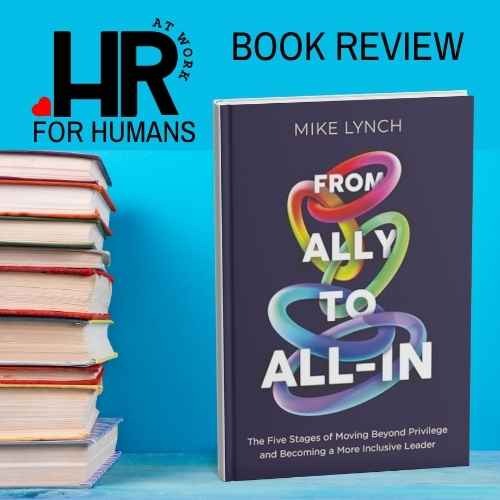
Can a workplace become more inclusive without turning every meeting into a courtroom? Read our review of From Ally to All-In by Mike Lynch to explore the challenge.
From Ally to All-In: The Five Stages of Moving Beyond Privilege and Becoming a More Inclusive Leader by Mike Lynch
Genre: Business and professional development nonfiction
Sub-genres: Leadership, human resources, inclusive leadership, workplace culture, diversity and inclusion, organisational development, executive coaching
Themes: Privilege, self-awareness, accountability, workplace equity, listening, leadership responsibility, personal growth, mentorship, representation, organisational culture, and sustained change
Review
What does it mean to support a principle when supporting it costs something? In a workplace, the answer may have little to do with a mission statement on a wall. It may be found in who gets interrupted during a meeting, whose contribution receives recognition, who is invited into a decision, or whether a leader challenges a remark that makes a colleague uncomfortable. These everyday situations sit close to the centre of Mike Lynch’s From Ally to All-In: The Five Stages of Moving Beyond Privilege and Becoming a More Inclusive Leader.
Drawing on his career in human resources, executive leadership, consulting, and coaching, Lynch examines the difference between expressing support for diversity, equity, and inclusion (DEI) and taking responsibility for putting those principles into practice. His intended audience is particularly clear: straight white male leaders who may have supported inclusion in principle without fully examining their own influence, assumptions, or behaviour. The book also speaks to a wider leadership audience and directly acknowledges the experiences of people from historically marginalized communities.
Lynch’s central framework consists of five stages: Awareness, Acknowledgment, Atonement, Accountability, and Amplification. The sequence offers a way to organise what can otherwise feel like an overwhelming subject. Awareness asks leaders to notice what they may have overlooked. Acknowledgment involves recognising their role and expressing that recognition. Atonement turns recognition toward making amends. Accountability focuses on maintaining responsible behaviour, while Amplification concerns using one’s influence to elevate contributions and perspectives that might otherwise be overlooked.
The framework is most useful when considered through ordinary workplace interactions. Imagine a manager who regularly interrupts one colleague but rarely notices the pattern. Good intentions alone will not correct it. The manager first needs to recognise the behaviour, acknowledge its effect, make a meaningful change, invite feedback, and help establish a team culture in which contributions receive appropriate attention. Lynch uses personal reflections and workplace examples to explore this movement from intention toward action.
The book also challenges the idea that inclusion belongs exclusively to human resources. Recruitment practices matter, but so do promotion decisions, meeting dynamics, access to mentorship, and the everyday choices made by leaders. Research on organisational psychology and team effectiveness has examined how psychological safety—the ability to speak up, ask questions, or admit mistakes without undue interpersonal risk—relates to team learning. Lynch’s emphasis on listening and accountability connects with this broader concern, although his framework should be treated as a practical model rather than a guarantee of particular business outcomes.
One useful feature is the material beyond the main chapters. A self-assessment guide, a 360-degree feedback tool, and a leadership cheat sheet give readers ways to reflect, seek input, and identify actions to practise. These resources help the book move beyond a discussion of values into the territory of professional habits.
Some readers may find the framework repetitive, and those seeking a detailed academic treatment of workplace inequality may want more extensive research and comparative evidence. Others may prefer a broader discussion of how the model should be adapted to different organisational and cultural settings. These are reasonable considerations for a book whose primary purpose is to guide leadership development.
From Ally to All-In is best suited to managers, executives, HR practitioners, coaches, and professionals willing to examine how their decisions affect colleagues. Readers seeking a neutral overview of every perspective in DEI debates, a comprehensive research handbook, or a quick formula for solving organisational inequality may find it less aligned with their needs.
Its lasting question is practical: what should a leader do differently after recognising a problem? Lynch’s framework gives readers a structured place to begin, while leaving the real test where it belongs—in their decisions, relationships, and conduct over time.
Content Warning: The book discusses racism, privilege, systemic inequality, workplace discrimination, mental health, and suicide statistics. These topics are addressed in a professional and reflective context.
Disclaimer and Other Relevant Information
The insights and any linked resources in our content are for informational purposes only and do not constitute professional advice. The opinions expressed in our articles reflect the contributors’ perspectives and do not necessarily represent the views of our entire platform. Please consult our policies for more information.
Here are the shortcuts to our policies that must be read along with each other:
- Terms of Service
- Disclaimer and Disclosure
- Privacy Policy
- Voluntary Contribution Policy
- Editorial Guidelines
- Content Submissions
For more details about us and what we do, here are some of the links:
- About Us
- Blog
- Book Review Request Step 3
- Book Reviews and Requests
- Contact
- Content Submissions
- Disclaimer
- Editorial Guidelines
- Humane HR Awards
- Humane HR Awards Winners
- Humane HR Book Reviews
- Humane HR Perspectives
- Magazine
- News
- Our Supporters
- Privacy Policy
- Subscribe
- Support Us
- Terms of Service
- Voluntary Contribution Policy
Here are shortcuts to our content:
- All About Humanising HR
- Book Reviews
- Compensation and Benefits
- Compliance
- Diversity and Inclusion
- Employee Engagement
- Employee Relations
- Humane HR Awards
- Humane HR Perspectives
- Humane HR Talk
- Morale and Welfare
- News and Announcements
- Performance Management
- Recruitment and Selection
- Talent Management
- Training and Development
- Workplace Change Management
- Workplace Communications
- Workplace Health and Safety
Nominate for the Humane HR Awards
Let’s recognise, celebrate, and encourage what’s making the world of work better. It’s free to nominate. Submissions are open all year-round, but why wait? Nominate today!



Leave a Reply